> For the complete documentation index, see [llms.txt](https://docs.xygeni.io/llms.txt). Markdown versions of documentation pages are available by appending `.md` to page URLs; this page is available as [Markdown](https://docs.xygeni.io/xygeni-products/application-security-posture-management-aspm/inventory/delivery-assets.md).
# Delivery Assets
The **Delivery Assets Inventory** displays information about the cloud assets in your project(s):
* Cloud configuration (dockerfiles, kubernetes deployments, etc)
* Cloud resources (any kind of cloud resource)
Extensive support of the main frameworks:
* **Terraform**: We provide detectors for a wide range of resources across major cloud providers such as AWS, Azure and Google Cloud.
* **CloudFormation**: Managed AWS service integration allows for detailed modeling and provisioning of AWS resources.
* **ARM** and **Bicep**: Tools for Azure resources, ranging from traditional ARM templates to the newer, more developer-friendly Bicep syntax.
* **Kubernetes**: Whether using basic Pods syntax or complex Helm charts, Xygeni ensures your Kubernetes deployments are secure.
* **Docker**: Our security extends to Docker environments, including Dockerfiles and docker-compose files that define services, networks, and volumes.
{% hint style="info" %}
You can reach the **Delivery Assets Inventory** page by selecting the Delivery Assets tab at the top of any Inventory page.
{% endhint %}
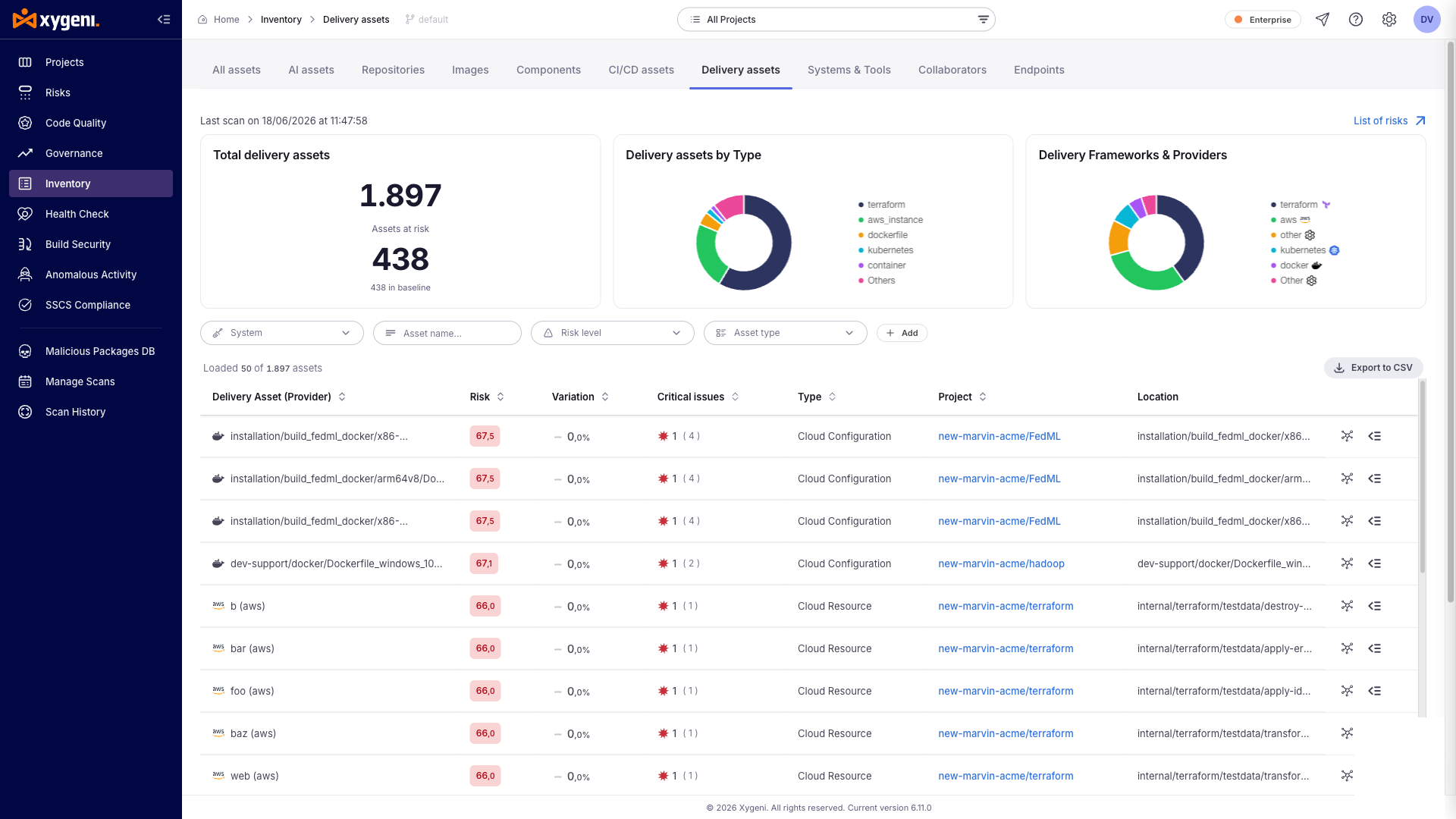
The **Delivery Assets** Inventory page displays the following information:
* Total number of Delivery assets and number of assets with security issues associated
* Distribution by type
* Cloud Frameworks and Providers detected
* A table with a full listing of all the Delivery Assets
{% hint style="info" %}
Clicking on the icon will show the [Pivot Graph](/xygeni-products/application-security-posture-management-aspm/inventory/all-assets.md#pivot-graph) for the selected asset.
Clicking on the icon of any asset will show the [Findings and Audit Trail](/xygeni-products/application-security-posture-management-aspm/inventory/all-assets.md#findings-and-audit-trail) for the selected asset.
{% endhint %}
---
# Agent Instructions
This documentation is published with GitBook. GitBook is the documentation platform designed so that both humans and AI agents can read, navigate, and reason over technical content effectively. Learn more at gitbook.com.
## Querying This Documentation
If you need additional information that is not directly available in this page, you can query the documentation by asking a question.
Perform an HTTP GET request on the following URL with the `ask` and `goal` query parameters:
```
GET https://docs.xygeni.io/xygeni-products/application-security-posture-management-aspm/inventory/delivery-assets.md?ask=&goal=
```
`ask` is the immediate question: it should be specific, self-contained, and written in natural language.
`goal` is what the user is ultimately trying to achieve, the reason they need the answer. Sharing it helps GitBook give you a better, more relevant answer. A goal is most helpful when it describes the outcome the user wants rather than restating the question. For example, with `ask=how do I create an API token`, a goal like `automate deployments from our CI pipeline` lets GitBook tailor the answer to that use case.
The response will contain a direct answer to the question and relevant excerpts and sources from the documentation.
Use this mechanism when the answer is not explicitly present in the current page, you need clarification or additional context, or you want to retrieve related documentation sections.
 icon will show the [Pivot Graph](/xygeni-products/application-security-posture-management-aspm/inventory/all-assets.md#pivot-graph) for the selected asset.
Clicking on the icon of any asset will show the [Findings and Audit Trail](/xygeni-products/application-security-posture-management-aspm/inventory/all-assets.md#findings-and-audit-trail) for the selected asset.
{% endhint %}
---
# Agent Instructions
This documentation is published with GitBook. GitBook is the documentation platform designed so that both humans and AI agents can read, navigate, and reason over technical content effectively. Learn more at gitbook.com.
## Querying This Documentation
If you need additional information that is not directly available in this page, you can query the documentation by asking a question.
Perform an HTTP GET request on the following URL with the `ask` and `goal` query parameters:
```
GET https://docs.xygeni.io/xygeni-products/application-security-posture-management-aspm/inventory/delivery-assets.md?ask=