> For the complete documentation index, see [llms.txt](https://docs.xygeni.io/llms.txt). Markdown versions of documentation pages are available by appending `.md` to page URLs; this page is available as [Markdown](https://docs.xygeni.io/changelog/version-5.9-march-26-2025.md).
# Version 5.9 – March 26, 2025
This release improves how users interact with the Xygeni platform, making it easier to assess risks, navigate insights, and manage security posture across the SDLC. With key enhancements to navigation, SAST visibility, and backend support, teams can move faster with greater clarity and precision—while strengthening their overall SDLC hygiene.
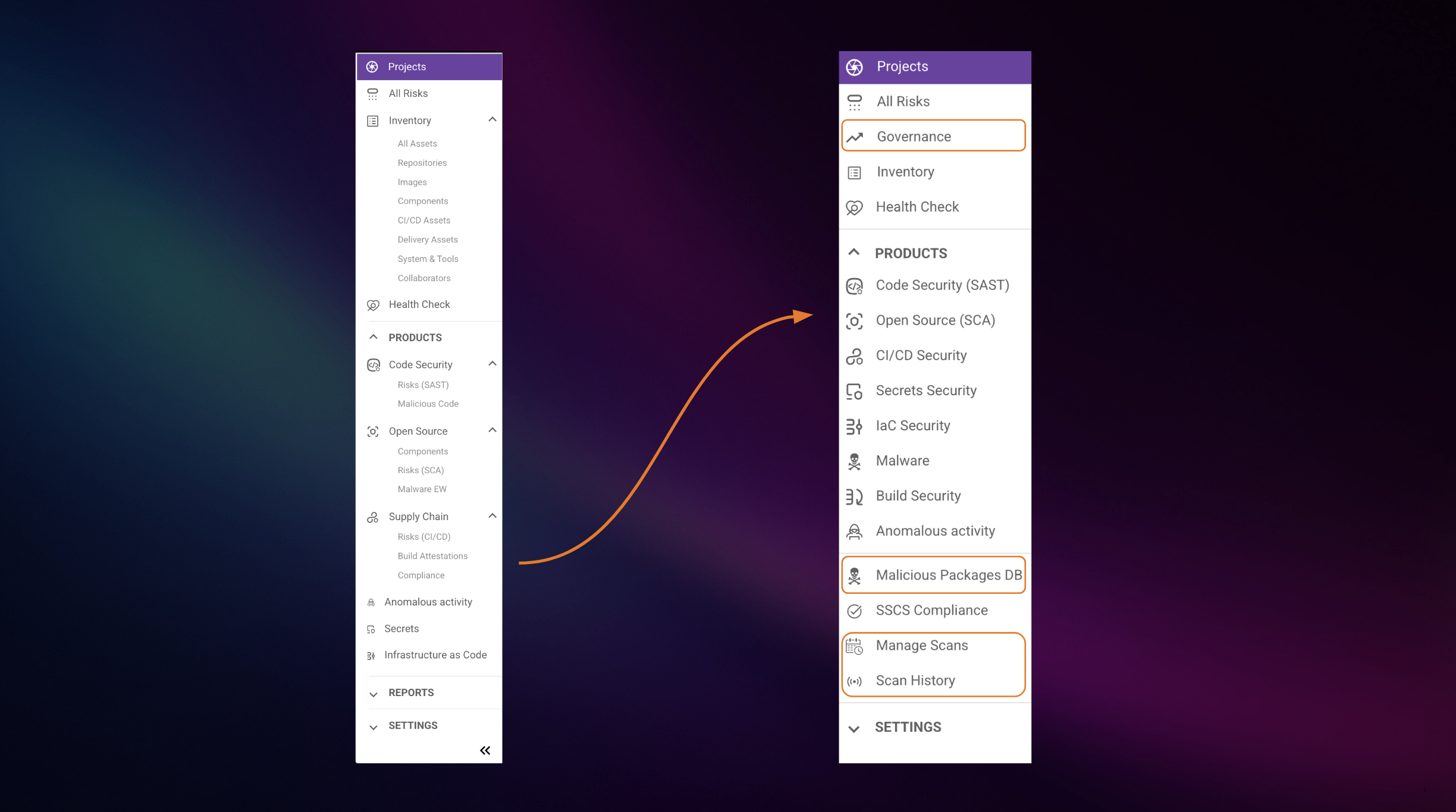
### New Navigation Structure
We’ve simplified the menu to align more naturally with Xygeni’s product suite.
* Risk types are now accessible with a single click
* Modules are easier to locate with a flatter layout
* Transitions across the platform feel faster and more intuitive
This change reduces friction in daily workflows and accelerates incident response. Security and engineering teams can now reach key data faster, improving operational efficiency and reducing the likelihood of missed threats.
Key changes include:
* **Scans → Scans History**: Renamed to clarify its role as the central log for all past scans. Users can review scan results over time and track activity across the SDLC.
* **Malware EW → Malicious Package DB**: Now listed separately from OSS to highlight its function as a global view of malware packages detected by Xygeni's Early Warning system—even if they don’t appear in scanned projects.
* **Manage Scans**: A dedicated entry point to configure SCM integrations and trigger first-time scans of repositories, making onboarding faster and more transparent.
* **Governance (Enterprise only)**: New section with dashboards on key ASPM metrics like issue trends, exposure windows, and remediation times—designed to help align teams with internal policies and SLAs.
### Redesigned SAST Risk Screen
The SAST risk view now prioritizes the most relevant information for faster decision-making.
* Key details like **vulnerability explanation** and **code location** are highlighted
* CEW information remains accessible without overwhelming the layout
* Full filtering capabilities are preserved
This allows teams to review, triage, and act on findings with less effort and greater confidence—crucial when managing high volumes of code and complex static analysis data.
### Detection, Performance & Usability Enhancements
This release also includes a set of improvements and fixes that enhance platform stability, expand coverage, and refine the overall user experience.
* **Improved ASPM support for Fortify**: Better integration and stability
* **Enhanced SCA coverage** for Go and .NET: Deeper analysis of dependencies and vulnerabilities
* **Extended CVSS v4 support**: More accurate scoring aligned with modern risk models
* **Subscription update enhancements**: Users can now adjust plans and capacity directly in the WebUI with fewer steps
These updates increase platform efficiency, reduce friction in administrative tasks, and improve the quality and relevance of security signals across technologies.
---
# Agent Instructions
This documentation is published with GitBook. GitBook is the documentation platform designed so that both humans and AI agents can read, navigate, and reason over technical content effectively. Learn more at gitbook.com.
## Querying This Documentation
If you need additional information that is not directly available in this page, you can query the documentation by asking a question.
Perform an HTTP GET request on the following URL with the `ask` and `goal` query parameters:
```
GET https://docs.xygeni.io/changelog/version-5.9-march-26-2025.md?ask=&goal=
```
`ask` is the immediate question: it should be specific, self-contained, and written in natural language.
`goal` is what the user is ultimately trying to achieve, the reason they need the answer. Sharing it helps GitBook give you a better, more relevant answer. A goal is most helpful when it describes the outcome the user wants rather than restating the question. For example, with `ask=how do I create an API token`, a goal like `automate deployments from our CI pipeline` lets GitBook tailor the answer to that use case.
The response will contain a direct answer to the question and relevant excerpts and sources from the documentation.
Use this mechanism when the answer is not explicitly present in the current page, you need clarification or additional context, or you want to retrieve related documentation sections.